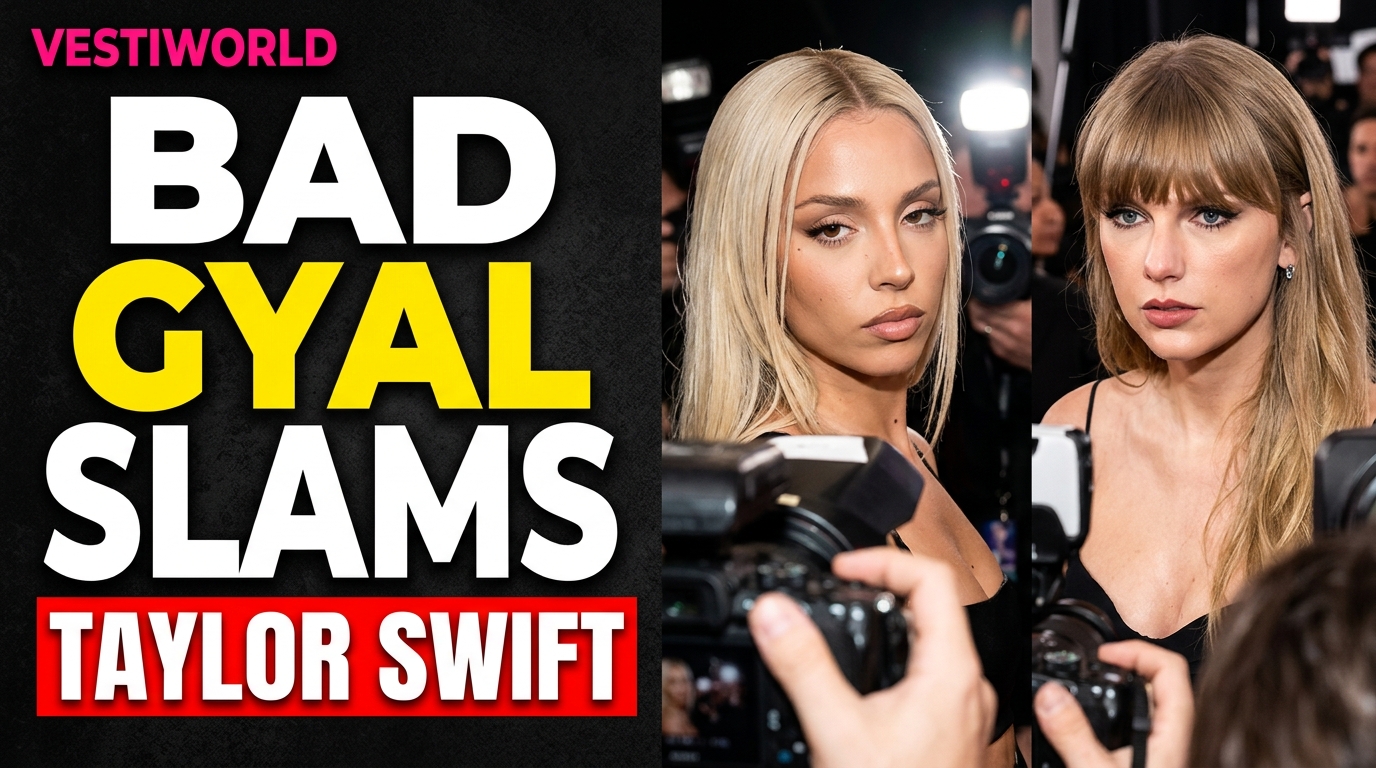

An explosive cross-continental music clash has detonated tonight with the sudden eruption of the Bad Gyal Taylor Swift feud. In an unvarnished interview clip circulating with furious momentum across X, the internationally acclaimed Spanish dancehall and urban music trailblazer declared unequivocally that she would refuse a musical collaboration with the American pop titan even for a staggering payout of three million euros. Bad Gyal did not stop at financial rejection; she took aim at Swift’s creative aesthetic, characterizing the billionaire singer’s catalog as bland and comparing her sonic universe to “dry chicken without salt or oil.” The razor-sharp critique has sent shockwaves through global music communities, sparking an intense clash between fiercely defensive Swifties and urban music loyalists.
The velocity of this controversy highlights the deep cultural fractures underlying contemporary pop dominance. As covered in global music trends by Rolling Stone, cross-genre and cross-language collaborations have become the standardized corporate strategy for global streaming empires. However, the unexpected Bad Gyal Taylor Swift feud represents an uncompromising rejection of that homogenized formula. Rather than viewing an association with the planet’s biggest commercial powerhouse as the pinnacle of achievement, the Spanish artist positioned authentic underground flavor as fundamentally incompatible with mass-market American pop packaging.
This viral confrontation opens a massive information gap that conventional celebrity blogs routinely oversimplify. Beyond the clickbait insult lies a profound ideological debate over artistic autonomy, cultural sovereignty, and the growing resistance among international urban artists against the bland commercial monoculture of Anglo-American streaming giants.
🚨 | Singer bad gyal is currently under fire after saying she wouldn’t collaborate with Taylor swift for not even 3 millions:
— pop_insider 🤍🖤 (@PInsider_) October 15, 2026
“Have you heard her music? Is like those memes, food with no spices (…) I don’t feel represented by her music”.
But she later recognized the singer… pic.twitter.com/oaqkiGEEaM
The Dry Chicken Metaphor: Deconstructing The Cultural Critique
To understand why the Bad Gyal Taylor Swift feud ignited such immediate outrage, one must examine the specific cultural weight of her metaphor. Describing someone’s music as lacking seasoning or oil is not a standard lyrical critique; it is a direct indictment of authenticity and soul. In Spanish and Afro-Caribbean urban music traditions, rhythm, raw sensuality, and visceral groove are the non-negotiable foundations of cultural resonance.
By using the culinary comparison, Bad Gyal struck directly at the primary artistic critique that has trailed Swift’s career from detractors: the perception that her music is hyper-engineered for suburban palates, stripped of dynamic edge to ensure maximum corporate palatability. Analysts at Billboard note that while Swift’s narrative songwriting commands historic commercial loyalty, her sonic palette has often prioritized lyrical confessionals over the dynamic, percussive energy that drives Latin urban dancefloors. The Bad Gyal Taylor Swift feud crystallizes that contrast into a punchy, viral cultural soundbite that resonates far beyond traditional fanbases.
For urban music fans across Spain and Latin America, the comments were celebrated as a courageous assertion of musical identity. For Swifties, the remarks were viewed as an unprovoked, disrespectful insult aimed at a globally decorated songwriting icon.
The Power of Saying No: Rejecting The Corporate Crossover Formula
What elevates the Bad Gyal Taylor Swift feud into an extraordinary industry event is the explicit rejection of the three-million-euro figure. In the modern music industry, streaming algorithms heavily incentivize international artists to bend their creative identity to secure features from English-speaking superstars. Major labels routinely arrange high-dollar collaborative tracks designed exclusively to unlock Western playlist placements.
By publicly asserting that no financial incentive could compel her to compromise her aesthetic, Bad Gyal performed a radical act of artistic independence. She rejected the presumption that every international performer secretly aspires to enter the American pop orbit. According to cultural commentators at Pitchfork, this defiance marks a significant turning point in global music power dynamics. Latin urban, reggaeton, and dembow artists now command massive global stadium tours and independent streaming leverage, granting them the financial stability required to decline corporate crossover overtures with total impunity.
The statement communicates a powerful message to multinational record labels: cultural credibility and genre purity cannot be bought with an executive checkbook.
The Swiftie Backlash: Mobilizing The Digital Defense
Predictably, the digital aftermath of the Bad Gyal Taylor Swift feud has triggered a ferocious counter-offensive from the world’s most formidable online fanbase. Swifties on X immediately flooded feeds with charts, Grammy tallies, and stadium attendance figures, arguing that the Spanish artist’s critique was a desperate attempt to manufacture relevance by attacking an untouchable global icon.
The defensive narrative deployed by fans framed the comments as jealous grandstanding. Commentators argued that someone operating in niche urban markets had no standing to criticize a songwriter whose thematic depth and poetic storytelling have defined modern music history. Fan accounts began circulating side-by-side lyrical comparisons, contrasting Swift’s elaborate literary metaphors with the direct club anthems of urban reggaeton.
This collision illustrates the fundamental linguistic divide in modern music consumption: a fandom that equates commercial supremacy and literary complexity with artistic superiority clashing with a culture that equates rhythmic impact, dancefloor energy, and raw attitude with genuine artistry.
Bad Gyal No colaboraría con Taylor Swift ni aunque me pagaran tres millones de euros tres millones de dólares, porque no me siento representada por sus ideas ni por su música es que me parece sosa como un pollo seco sin sal ni aceite. pic.twitter.com/pWTUr3Fuk9
— 2000s 🇺🇸 (@PopCulturetini) October 15, 2026
The Shifting Global Hierarchy of Pop Music
Looking beyond the timeline skirmishes, the Bad Gyal Taylor Swift feud serves as a compelling barometer of the changing geopolitical landscape of popular culture. For decades, American pop music functioned as an unassailable global monoculture to which international scenes were expected to pay deference.
That historical hierarchy is rapidly crumbling. As regional genres thrive independently across Europe, Latin America, and Africa, artists no longer measure their value through the prism of American acceptance. The Bad Gyal Taylor Swift feud is not an isolated incident; it is symptomatic of an era where regional authenticity holds greater currency than sanitized global consensus.
When an artist openly declares that their creative identity has nothing in common with the biggest star on earth, they are not courting failure—they are staking their claim on a decentralized cultural future where multiple kings and queens rule separate musical kingdoms.
Vestiworld Take
The lasting resonance of the Bad Gyal Taylor Swift feud marks a refreshing, chaotic disruption in an industry that has grown suffocatingly polite. Corporate public relations typically sanitizes every interaction between major artists, reducing the music ecosystem to forced smiles and synthetic mutual admiration.
By speaking with raw, unvarnished honesty, Bad Gyal injected genuine friction back into the pop conversation. The debate she sparked forces audiences to confront what they truly value in art: is it the pristine, universally digestible perfection of an American stadium titan, or the unapologetic, fiery attitude of an urban innovator who refuses to water down her soup? As the debate continues to rage across timelines, one conclusion remains undeniable: the Bad Gyal Taylor Swift feud has proved that in the modern music colosseum, true artistic attitude cannot be bought at any price.
For More Stories :
Sophie Rain Drake Clip Drama: Inside The Viral Podcast Machine Weaponizing Hip Hop Rumors
Enty Blind Item 12 Disney: Inside The Dangerous Online Hunt Shaking Hollywood
K-Pop Industry Grammy Category Boycott: The Global Power Play Shaking The Recording Academy
Sydney Sweeney Novig Ad Backlash: Inside The Controversial Campaign Shaking Sports Media
Brooklyn Beckham Nicola Peltz Paris PDA: The Eiffel Tower Kiss That Deepened The Family Rift